Monday, August 08, 2011

Missing president notice: where the hell is Paul Biya?

On July 17, Cameroon's president Paul Biya, left the country for three-day state visit to China. While there, China promised more money, Biya promised more resources and contracts were signed. Then Biya disappeared.
Missing President.  Photo. Finbarr O'Reilly/Reuters
It should be said that this is not Biya's first or last fugue. Among African or one could dare say world leaders, Biya is easily the one who spends the least time actually running his country. In a year, it is reported that he spends about 150 to 200 days outside the country, mostly in Geneva, Switzerland, where is young children school and where he seems to have a permanent residence at the Geneva Intercontinental.  It reached a point early this year when a group of Cameroonian activists in the video below, staged a protest at the hotel.


After every trip abroad, Biya rarely goes home directly. There's always a Geneva stopover for a couple of weeks, but never over 40 days. After a 40-day absence, there is a risk of the presidency being declared vacant and fresh elections called. The state-controlled media describes the trips as "brief short visit" or "brief private visit". However, it is not like him being in Cameroon will make a difference. A resources and manpower-rich nation, which was suppose to be the economic motor of the Central African region has slumped into a miasma of corruption, fainéantisme, state-sponsored sycophancy and economic decay with millions of youths reduced to paupers. In a recent book an AFP colleague, Fanny Pigeaud writes of Cameroon's government under Biya as an authoritative but lax regime that has plunged Cameroon to the bottom of every economic and social indicator since Biya came to power in 1982.
"While maintaining and deepening former president Ahidjo's dictatorial style of governance, Biya has introduced other trends and features such as neglect, inertia, and criminality within state structures. Together, all these has resulted to an unproductive and paradoxical system. For nearly 30 years, Cameroonians are subjected to power wielded by their leaders who are doing everything to stay in power without governing the country," she writes.
"Cameroon is a country where two years could go by without the president presiding a cabinet meeting, where the head of the police can imprison an innocent person for murder to cover a guilty one; or where a citizen could call police emergency to report that they have just witnessed a woman being assaulted and want to make a statement, only to told: "But let the woman come and complain herself! What is your business in it?" before getting hung up on; where the president pays with suitcases stuffed with cash when he buys jet fuel for his plane; ...where it takes two days to find the remains of a Boeing 737-800 that crashed, with 114 passengers, thirty seconds after take-off," Pigeaud added.
Cameroon is expected to hold presidential elections in October, yes in about two months. Though 78-year-old Biya has not said whether he would be seeking another mandate, his sycophantic crowd have been on overdrive in the past months, printing books, pamphlets and holding rallies, urging him to run. Biya had somewhat shown his intentions in 2008 when he orchestrated a constitutional reform which removed presidential term limits, effectively, according to their calculations, clearing the way for him to run again if he wanted. So, two months to elections, there are no campaigning, no primaries. Cameroonians are in suspense, waiting for Biya to decide whether elections will be held and if he would run. Even his own political party is stuck in the limbo. Potential successors cannot openly challenge him or even been seen to be vying for the throne because they'll find themselves in jail so fast on corruption charges, like others before them.

Meanwhile Biya is holed up somewhere in Geneva, no explanations, nothing, nada, while a nation awaits, as it has always done. But for how long? Egypt? Tunisia? Libya? Syria?

Thursday, August 04, 2011

Senegal Holiday in pix - Dakar - St. Louis - Dakar

On the road. The drive from Dakar to St. Louis was pretty easy on a very good road. The landscape is breathtaking if you have the time to stop and admire the baobab trees that dot the semi-Sahel vegetation.


Baobab dotted landscape en route to St. Louis   photo. BF


Semi-Sahel vegetation


Passengers perch atop a bus

Sometimes you do have some ghastly accidents
St. Louis: Former the capital of Senegal during French colonisation, has gradually lost some of its lustre. Though endowed with some very attractive sights, St. Louis or Ndar as the locals call it in Wolof, seems to have stood still since the colonial era. In the main section of the town, you'll hardly find new constructions, partly because most of the colonial houses are somewhat national treasures. However, most of them are in dire need of renovation. Also, the city and the river Senegal, whose two branches cut across the city from north to south, leaving a narrow island of just over 2km long and about 400 metres wide,  is heavily polluted. But it is worth the trip. 

A stray dog catches a beautiful sunrise in St. Louis

The city's landmark  Faidherbe bridge under renovation

All kinds  of rubbish 

A horse-drawn cart rides past colonial building along the old quay

A woman walk past a row of colonial houses along the quay


Snap Shadow
Mboro: Senegal's garden belt. 


All around the camp are thousands of gardens

About 3km away from the city and the camp is the Mboro beach
Trying to eat a Mango 

  Back in Dakar: Senegal traditional wrestling, the national sport.
 The this is huge in Senegal. The fans love it. The big fights bring the nation to a standstill.
Fans trashtalk before the big fight
 
Mouhamed Ndao, aka Tyson's marabout prepares his gris-gris

A wrestling awash himself with magic potions before the bout


Tyson warms up before the big fight against Balla Gaye 2
The Demba Diop stadium is packed to the rafters
Balla Gaye 2 fans celebrate his win over Tyson


Tuesday, June 28, 2011

Cameroon, Senegal: Miserable old buggers won't quit

Its not ageism. It is just that I have had it with some of these miserable old farts at the helm of some African countries. Merde!. Why do we have to suffer these old fools who continue to cling to power despite decades of spectacular failures as  leaders.

Take the case of Abdoulaye Wade in Senegal, legally about 84-years-old, but rumoured to be on the wrong side of 90. Yes he came to power late in his political life, but has had 11 years to at least lay the foundation for what ever vision he had for Senegal. Instead what does he do? He engages in the old game of tinkering with the constitution to try and prolong is stay in power.

This has served as a catalyst for pent-up anger and anti-government sentiments to explode. We've had a series of riots in the past week alone. First over the proposed constitution change, then over excessive load-shedding that had left some neighbourhood without electricity for over 48 hours. It is clear Wade is not longer energetic to be able to stay on top of the burning issues of poverty, unemployment, corruption etc., that is plaguing the country, but he is insisting only he can bring salvation to the country, pissing off a whole section of the population that can't wait to get him out come presidential elections billed for February next year.

Caricature of Biya saying we are unshakable.  Author unknown

 Another is Cameroon's 78-years-old Paul Biya. This is a guy who is been in power for over 29 years Yes 29, one of Africa's longest-serving presidents. But Cameroon remains one of the world's worst governed country. Corruption is rife in every sector of the country. The economy, albeit with great potentials, has stagnated for decades due to mismanagement, lack of vision, heavy state bureaucracy, and downright theft orchestrated by the ruling class.

Biya himself as an absentee landlord who spends more of his time outside the country. It has been recorded that in a given year, Biya spends over 150 days or more out of the country, particularly in Switzerland where his young children from a second marriage attend school. Early in his regime, he was asked about his prolonged absences from the seat of power and his answer was..."Cameroon was on auto-pilot". Go figure.

In 2008, aided by the sycophants in parliament, he removed presidential term limits from the constitution and is expected run again in elections planned for October this year, meanwhile the country continues its long decay while tensions continues to simmer. It will one day get to the point where it would explode just like in Senegal now and as it started in north Africa early in the year.

Sunday, June 12, 2011

Painful dune walkabout

So, I went to check out the scenic Lac Rose. I decided not to book any of the guided tours on quad bike, camel or 4X4. The plan was take couple of pictures around the lake then walk the suppose less-than-800 meters across sand dunes separating the lake from the Atlantic seaboard.
Firstly don't believe guide books. When they said less-than-800 meters, they forgot to precise that that distance was as the crow flies between two shortest point. If you are going to hike up and down dunes, zigzag through a smallish pine forest, the distance is more like 1.5km. Oh! and it is scorching hot.


                    Hiking on dunes is a pain                                   Photo - BF
I yielded to pressure from local guides and hired one of them to go with me after they told me it was dangerous to go walking about the sand alone. So we set off with Diop, my guide, after he reassured me that the coastline was just beyond the sand, he said, pointing towards the dunes the eye could see.
After the first hundred meters, I realised walking on sand with flip-flops was uncomfortable and slow, so I took them off. Big mistake. It was hot, very hot and it felt as if my soles were roasting. Back to the uncomfortable flip-flops. It was impossible trying to get any kind of traction walking. I was more like plodding along and after 200 meters, I felt a sharp pain on my lower back. 


Diop had to halt several time to wait while I catch my breath    Photo - BF 
 "Je vois que vous n'est pas en forme," Diop said as I bent double, holding my waist to catch my breath and rub my lower back. The nerve!  But I was not going to admit that I was out of shape. Turning back was out of questions so we continued. But after another hundred meters I was ready to surrender. I needed to sit or lie flat on my back to ease the pain. 
I should have hired a quad bike, a 4X4 or a camel at the nearby camp I thought. At this point I really didn't think I'll make it back. I was thirsty and somehow had manage to forget my water in the car. I asked Diop if it would be possible to hitch a ride back with one of the cars or quad bike on our way back. He said not a chance. You are suppose to register first, they are all booked out, he said. Oh merde!


Diop advances while I plod along                    Photo - BF                            


The sea is just beyond the pine trees            Photo - BF

We finally made it out of the plastic-littered pine woods, up the last dune to the Atlantic seaboard.
Voila! je vous avez dit que c'est n'est pas loin, Diop said, totally zen like he just did a stroll across the park while I finally succumbed and crumble on the sand, clutching by sides. 
Tu parles!.
I was no longer interested in the vista the greeted us. All I wanted to do was lie there and never stand up again, but I had to think of the return journey. Why didn't I just sit by the lake and drink cocktails or go float on the salty waters of the lake. Eish!


Band of brothers from a nearby village take a stroll   photo - BF


Saturday, June 04, 2011

Football: Could the Lions put an end to this Senegalese smugness

Senegal vs Cameroon AFCN Qualifier in Dakar

I have had it. Since Senegal manage to earn a die-minute 1-0 victory over Cameroon back in March, every Senegalese I come across put on an air of smugness whenever they find out that I am Cameroonian, like they won the World Cup or something. 

The other day, it was a traffic cup. While doing a routine check I handed over my drivers licence, he had one look and smirked. 

"Tu est Camerounais,?" he asked. "Oui," I replied. 
"Oh je suis désolé pour vous," he said, handing back my licence and then called over a colleague.
"Eh! Diop, hahahah, il est Camerounais, un supporteur des Lions Indomptables," and they both continue to laugh as I drove off.

The same scenario has played out countless of times since the March victory.

The nerve!

You see, to Senegalese fans, beating Cameroon was like winning the World Cup and at the same time delivering them from a long-suffering they have endured for nearly 20 years.

Cameroon has been very mean to Senegal when it comes to football. Back in the 90s when Senegal had good crop of talents, they hosted the African Cup of Nations in 1992, hoping to win it or at at least make it to the semis or the final. Only one team stood in their way, those terrifying Cameroonians.

Before the quarter-final game, some Senegalese players such as legend Jules Bocande, went about boasting that they'll trash Cameroon, that the Cameroonian squad was made up of old players living in past glories and were still in the dream of their epic exploit at the World Cup in Italy, two years before.

Now for those who know the Cameroonian team of the late 80s, 90s and early 2000, that kind of trash-talking enrages the Lions. Go ask the Moroccans, Ivorians, Nigerians and Malians. On the day of the quarter-finale game in front of a packed home crowd against them, the Cameroonians did what they do best in such circumstances; break the heart of a whole nation with a one-nil win.  

The Senegalese were inconsolable. From Bocande bawling on the pitch, to the agonising fans, threatening to throw themselves from the rafters of the stadium.   

Then in 2002, a new generation of Senegalese talents emerged. The team that included El Hadji Diouf, Khalilou Fadiga, Papa Bouba Diop, Ferdinand Coly etc, went to do great things at the World Cup that year, beating France and going on to play the World Cup quarter-final. But before that, they had an old score to settle, they had to beat Cameroon in the African cup of nations that year. 

After disposing the host nation Mali, in display of football master-class in front of a hostile home crowd, Cameroon met Senegal in the final. The talented Senegalese did everything they could but Cameroon held its ground and the final was decided on penalties. Of course Senegal went home heartbroken again. 

So when they finally beat their "bête noire" in March, it is understandable that they should be happy. But I think rubbing it on every opportunity they get on every Cameroonian, and being smug all the time, I think they are asking for it again. We have done it before and we'll start all over just to make it clear that Cameroon is the Indomitable Lion. On this June 4 day in Yaounde, could the Lions please put an end to this smugness.

Friday, June 03, 2011

Dakar scenes

Baobab tree on Île de Gorée - Pic BF

Baobab alley, Artists resting - Île de Gorée

Cliff on Île de Gorée 
Grande Mosque on Ouakam beach

Beautiful sunset off Ouakam beach
My local beach - Ngor. Exactly 10mins from home 


I found these walls on Ngor island facinating

Doorway to the sea - Ngor island
Unfortunately no waste disposal plan - Ngor island

Wade's African Renaissance monument

Tuesday, May 31, 2011

We are back!

Transport to Ngor Island - Photo by Bate Felix
Finally. I've decided to start blogging again. I moved to Dakar, Senegal from Brussels at the end of February to start my new assignment as Reuters Correspondent for West & Central Africa.

The Reuters team of four Dakar-based text correspondents plus stringers in all the countries, cover news stories ranging from politics and economics to general news stories in over two dozen countries from Senegal to the DRC, excluding Nigeria.

There is a lot going on in the region in which I'm very passionate about. Some of the funny, sad crazy or inspirational stories and encounters I'll come across may not make it to the Reuters wire, so I'll be sharing them with you right here. Stay tuned.!

Wednesday, January 20, 2010

Coming soon

This blog will be revamped in the coming weeks. Stay tuned!.

Saturday, September 23, 2006

Eish!!! it's been long

Yeah! i know, it's about time, it's been a while since i last posted anything meaningful here. Not that i have not been writing anything worthwhile to share, it's just that i had to rethink what goes in here.

This blog was created when the concept of blogging was in it's infancy. It started as a class project for the Online Journalism course. It became my Online portfolio where i published some of my stories as i went through my internship.

But as with everything, it became imperative that i reconfigure this space and give it a better sense of purpose or shut up. Really who would be interested in reading articles published elsewhere, just because i wrote them...exactly, that's why i had to stop and rethink this whole thing.

So what do i want to say in this space...i know there's a proliferation of blogs out there, ponderings of both the apt and the inept, sane and inane...from myspace to yahoo360 you can find yours.

I did try something on yahoo 360, but realised earlier that it's not what i wanted, neither is myspace. They have one thing in common which i find distracting. They are all cluttered with too many people invading your space wanting to be your friend, online buddies and before you know it, you have followed the rabbit down the hole to their space and their friends friends friends friends...see what i mean, you get lost in other people's spaces.

So back to good old blogger, the space for my meaningful and sometimes useless thoughts, for profound but sometimes profane thoughts (as my friend www.electricspaghetti.blogspot.com) would put it.

I am back

Tuesday, December 13, 2005

Youths at the Service of Youth


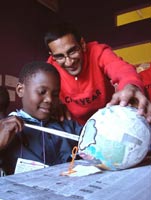
City Year Volunteers in Action


Bate Felix

First Published on IPS

JOHANNESBURG, Dec 7 (IPS) - They've spent the past year confronting many of South Africa's problems head on, from the high incidence of rape to the fact that many school children battle hunger. They expected nothing less.

These are the young men and women from the first batch of City Year South Africa service leaders: a group of youth volunteers who worked on various projects in Johannesburg, South Africa's commercial hub, in 2005.

The City Year initiative is based on a U.S. programme pioneered in 1988 by two students from Harvard University, Michael Brown and Alan Khazei, in the eastern city of Boston. The law school roommates believed that young people could be a powerful force for addressing social ills if given a proper forum to do so -- and also gain valuable skills in the process.

The first fifty volunteers for City Year in the United States spent the summer of 1988 working with disabled persons, the elderly -- and in assisting with environmental and housing projects in Boston. Today there are about 1,000 volunteers deployed in cities across the country.

South Africa's version of the programme got underway this year with 109 volunteers between the ages of 18 and 25, many having taken time off from their studies to participate. The volunteers were divided into groups of 10, then sent to schools and a community centre in Johannesburg.

Even though they were selected largely on the basis of prior experience in volunteering, many say that nothing could have prepared them for their City Year. The work was both tiring and inspirational noted 19-year-old Aletta Smith, voted the best service leader of the year by her peers during a ceremony marking the volunteers' graduation.

Some of the biggest challenges, she said, had come in trying to work as a team with people from different backgrounds -- and in dealing with situations where she felt powerless to help: "Like the case of the little girl-victim of a rape." However, "City Year is structured in a way that helps us deal with these kinds of situations, at a personal level and in trying to help the children we are working with," she added. "We fall back on our team leaders for guidance, and if they cannot help we can depend on other structures within City Year, where counsellors, advisers, training and debriefing sessions are provided so that we can cope with situations we encounter."

Nishe Naidoo, 19, also spoke of having to overcome stereotypes while dealing with volunteers from other backgrounds -- and of how the people they tried to help could sometimes be uncooperative. "There were times when I wanted to give up, a thousand times even, like having to deal with a difficult child or somebody rubbing you the wrong way," she said. "But motivation from friends and the system put in place by City Year to guide and give us counsel kept us going."

One of the main ways in which City Year volunteers assisted communities was through supporting after-school programmes, where children from poor communities received extra classes in mathematics and other subjects. The volunteers also helped children with their home work and various extramural activities.

"Before they came, we had no after-school programme. In fact, after two o'clock the teachers just wanted the children to go away because they are so stressed -- acting at the same time as teachers, social workers, psychologists and, to an extent, parents," said Olga da Silva, headmistress of Goudpark Primary School where 16 teachers cater for 650 pupils. "At the end of the day, it was just too much for them." Goudpark ("Gold Park") is situated in Eldorado Park, an area mostly populated by mixed-race South Africans -- a legacy of Apartheid-era segregation. Unemployment is rife, as is gang activity. In this context, after-school activities play a crucial role in keeping children off the streets, and out of gangs.

The volunteers at Goudpark also initiated a school feeding scheme, after they realised that hunger was making the children in after-school care inattentive. They persuaded local shops to donate food, something which prompted women from the community to volunteer in preparing meals that now feed up to 100 children a day.

City Year South Africa is affiliated to the National Youth Service, set up by the South African presidency to promote youth service in the country. It is run as a non-profit organisation, and funded by business, charitable foundations, individuals and the government.

Although the volunteers do not receive salaries, they are provided with a monthly allowance of about 95 dollars, and money for transport. After their year in service, they also receive bursaries of just under 950 dollars to pay for tuition (for those who intend resuming their studies), or to use as seed money for setting up a business.

Thirty-eight members of the first batch of volunteers have signed up for another year in service, and will be working as team leaders for the 170 new recruits scheduled to join City Year in 2006. For now, the programme is only operational in Johannesburg, although there are plans to extend it to other cities in the country.

This year the volunteers -- distinctive in their bright red jackets and khaki trousers -- helped over 2,000 children. However, Teboho Mahuma, executive director of City Year South Africa, says the initiative is modest in its intentions: "We have no illusion of getting an answer to every societal need." The benefits lie elsewhere.

"It has opened my view of South African society. You hear things and you don't really believe it's true, but being here in the field and working with the children every day has opened my eyes to the realities of our country," said Letitia Jackson, 19. (END/2005)

Thursday, December 08, 2005

Storm over Zuma case secrecy

Bate Felix

First published on the www.journalism.co.za website

The South African Editors Forum (Sanef) and the Freedom of Expression Institute have condemned the secrecy and exclusion of the media from the court appearance of former deputy president Jacob Zuma on rape charges.

Zuma appeared in the Johannesburg Magistrate's Court on Tuesday morning. According to media reports, the media and the public were bared from the proceedings.

The Star newspaper reported that the court was "surrounded by an army of bodyguards, as Zuma entered the courts through a side door generally used for prisoners". Journalists from the newspaper were prevented from attending the proceedings by heavily-armed police officers and bodyguards at the courtroom door and a photographer was prevented from taking pictures… when Johannesburg Police Area Commissioner Oswald Reddy was questioned about the illegal exclusion; he replied that – "This is highly confidential, no one is allowed in," the paper reported.

Also, it was reported that there was no sign of a charge sheet against Zuma, nor was there an entry in the court log that Zuma had appeared there.

Sanef deputy chair person Elizabeth Barratt said that the events of the Johannesburg Magistrate Court are reminiscences of the past: "This is the journalism that we used to know, with things happening behind close doors and the media being kept out."Sanef issued a statement saying that it is alarmed at this secrecy, which is contrary to the spirit of the Constitution and the openness and transparency of justice for which it stands.

It said it believes that all citizens should be equal before the law and special treatment should not be given to the rich or powerful in society. Barratt added that Sanef was going to discuss the issue and decide what to do.

After his appearance in court, Zuma issued a statement through his lawyers in which he stated that he was deeply disturbed that what is purported to be evidence has been led in the media. The statement said that this had severely influenced public opinion on this matter, causing him great prejudice. "…as with the corruption case; the media has passed judgement…" the statement read.

The Freedom of Expression Institute (FXI) condemned "the harassment of the journalists in the court house and the action of the area commissioner to unilaterally declare the proceedings in camera".

Jane Duncan of the FXI said it was "absurd, and smacks of collusion between the police area commissioner with Zuma's team to shield him from further public embarrassment. In fact the police became an extension of Zuma's bodyguards," Duncan called on the journalists concerned to lay complaints with the Independent Complaints Directorate.

She added that section 153 of the Criminal Procedure Act governs circumstances when a court can be closed. In terms of this provision, the court must make the decision, not the police. It was not the role of area commissioner Reddy to usurp the magistrate's powers to decide whether to close the court.

Zuma's appearance was preliminary, so the provisions around the closure of the court to protect the testimony of the accused or witnesses simply would not apply in this case. The police therefore violated s.153 of the Act as they did not follow due process in having the closure of the court considered by the court itself, according to Duncan.

The Star reported that presiding magistrate Johan Boudrix said he was surprised to hear the media had not been allowed into court. He said there had been no application to hold proceedings in camera, and as far as he was concerned the court had been open. It also reported that the Chief Magistrate of the Johannesburg Regional Court, Gert Jonker, said that the court case, as far as he was concerned, was an open matter, and there was no ruling preventing the media from attending the case.

The trial is set to begin on the 13th of February 2006. Jane Duncan warned that "these events bode ill for the media's ability to cover the trial as it unfolds and sound warning bells that attempts may be made by Zuma's team to hold the trial in camera".

Wednesday, 07 December, 2005

Did he or didn't he? Should the media have published or not?

Compiled By Bate Felix

First published on the www.Journalism.co.za

Since the Jacob Zuma rape saga broke over the weekend, the media has been struggling to make sense of it. We present a compilation of the most important reports and comments.
;@import url("./editor-adm/style.css");
@import url("./editor-adm/style.css");
The Sunday Times broke the story with a front page lead: “Zuma Rape Claim”, The story said former Deputy President Jacob Zuma has been accused of raping a woman at his house in Forest Town, Johannesburg. They had spoken to the woman who was unwilling to confirm it. Quoting unnamed police sources, it said the police have allocated senior investigators to the claim, although there was no official confirmation.
Extraordinarily, Independent’s Sunday Independent and Sunday Tribune also led with the story – but said exactly the opposite. Under the headlines “Double Blow for Zuma” (Sunday Tribune) and “Double blow for Jacob Zuma hit by dirty tricks campaign” (Sunday Independent), Jeremy Gordin’s story quoted the woman – and named her – as denying the claim flatly. Members of the Zuma camp dismissed the allegations as a “dirty tricks campaign” against him. Significantly, although her name appears in the hard copy editions of the papers, the versions posted online have had the name removed.
Most online publications like News24, and M&G Online picked up quickly on the stories and tried to take them further, but could not get much further than to highlight the possibility of legal action being taken against the Sunday Times.
In “Zuma sex charge 'confusing'“, news24 reported that the Democratic Alliance had entered the fray, and was intending to ask parliamentary questions about the issue if the police failed to do so. The DA justice spokesperson Sheila Camerer quoted as saying “It is quite extraordinary that different newspapers carry totally different versions of events”
Still on Sunday, SABC News, and other online publications also reported that Zuma, through his lawyer was dismissing the allegations, while the ANC remains tightlipped.On Monday, the confusion persisted as SAPA looked at the various reports in the media, as this article picked up by M&G online, Iafrica and SABC News.com shows .
While the Sowetan was asking “What Rape?”, Beeld and Die Burger led Monday's newspapers with the headlines: "Rape storm rages around Zuma and Aids activist", with Beeld publishing a photo of the woman, with more information about her.
In a news analysis headlined "Fact and fiction amid innuendo and rumour", Business Day said that whether true or not, the claims would damage both the alleged victim and Zuma. The Daily Sun headlined: "Zuma to take legal action?" While Nova proclaimed: "No answers in Zuma rape claim".
Meanwhile, The Star in an article ‘I viewed Zuma as a father’ said the “woman again denies former deputy president raped her”.The article also said that she had refuted any claim that she had laid charges and she was on her way home to Swaziland, because her grandfather was ill, But she confirmed that she had stayed overnight at Zuma’s home last Wednesday. All she was prepared to say about that evening was: “I stayed the night and I left the following day to go to work.”
It was also reported on Monday that Zuma would be meeting with his lawyer to decide what to do about the rape claim.
Amid a growing storm, Cosatu and the SACP criticised the Sunday Times for running the story. Cosatu slammed the paper for publishing the story, saying they “smell a rat” in the whole affair.
But the Sunday Times issued a statement that it stood by the report. It said: "The Sunday Times is 100% certain that our story that there is a police investigation into a rape complaint against former deputy president Jacob Zuma is accurate."By Tuesday, however, the Independent titles were reporting categorically that a charge had been laid at the Johannesburg Sexual Offences Unit. The report said: “Impeccable sources have revealed that a complaint, the basis of a police investigation, has been registered at the Braamfontein-based unit. But the complaint was described by one source as "flimsy, riddled with contradictions and won't hold water,” according to the report.
The report also said that Zuma had met the mother of the victim as a damage control exercise and that the mother flew to Johannesburg to speak with her daughter. But it was later denied that this meeting ever took place.
Meanwhile the ANC said it was treating the whole thing as a rumour, according to the SABCNews.com web site.In a carefully argued editorial, Business Day argued that it was essential for the police to clarify whether a charge had been laid or not.
And Prof Anton Harber, of Wits University, argued in his "The Harbinger” column on this website that the real story about the claims were around the dirty war being fought by different factions in the ANC.
Should the story has been published? You can vote in our poll, and add your comments.Compiled by Bate Felix

Business maverick launches

Bate Felix

First published on the Journlaism.co.za website

Branko Brkic’s desk is cluttered. Magazines, pictures, papers are strewn around. He works simultaneously on a laptop and desktop PC, with a packet of roast peanuts close at hand. A phone rings. He scrambles for it, finally retrieving it from under the mess on his table.

“As you can see we are on deadline,” he says apologetically. As the editor, he is frantically putting finishing touches to the first issue of Maverick, a new business magazine that is due to hit the stands on November 3.
Our conversation is constantly interrupted by members of his staff who want him to have a last-minute look at some details, as he try to describe what Maverick is all about.

“Essentially, people want to read magazines that they enjoy. What is the point if you don’t read through and enjoy a business magazine? It does not have to be boring!”

At the moment, he says, you rarely find a business magazine that leaves you yearning for more because it’s a compelling read.

“When was the last time you got a South African business magazine in your hands and you said – I can’t wait for the next issue, a magazine that you want to take home with you and not leave in the office or just thumb through it – you see what I am saying?”

Brkic says his responsibility is to the readers. The former editor of Brainstorm, an IT magazine, says: “I want to say to people, ‘for Christ’s sake let’s read the business magazines. Business is the most enjoyable thing, we spend so much time on it every day, so why the hell must we address it as the most boring subject?”

“I look at Fortune magazine and I see people love it. In South Africa, they have 14000 subscribers, and I think - they are doing something differently”

It is that style that he wants to emulate. “How do we position ourselves to be enjoyed?” he asks.

And he thinks he has the answer with Maverick - “a good business read, must be interesting and fun”.

“Maverick is a business magazine for business people who don’t see the upside of being bored, it is informative but engrossing and good looking – it is a business magazine for people with brains and money,” says the marketing leaflet.

It also says that the “world of business is filled with intrigue, bloodletting, backstabbing and more fascinating stories than you could shake a stick at,” and that these are the stories Maverick is dedicated at telling.

Brkic says he noticed that people don’t particularly read outside their competence, - miners rarely read what is happening in finance, bankers rarely read what is happening in engineering - he wants to change that he says, “by marrying these different elements and making them interesting”.

The problem, concedes Brkic, is that “you have to know how to do it, and the ultimate judge of that will be the readers”. He thinks Maverick might just be able to pull it off because he refuses to see any competition.

“My opinion is that we are coming into a market that nobody is in, in South Africa”. He refuses to comment on existing business publications.

Brkic says the magazine will be for Mavericks and not about Mavericks. It is a mindset, regardless of gender or colour, he says. Though targeting the higher LSMs, Brkic says they will be looking at the huge 25 – 35 age group, who are just entering the business world, and who do not feature on any radar screens.

With an initial print run of 30 000 copies, four-weekly publication and a cover price of R 27.50, he says he aims to serve the market with something new.

In a recent article on financial journalism in The Media Online, columnist David Bullard said “the presentation of financial news has become so dreary that only those with a high threshold of boredom can cope with reading a business paper these days”.

He went on to advise that “If the financial papers lightened up a little they might stand a better chance of attracting new readers”.

It seems to be this irreverent advice that Brkic wants to take with Maverick.


Wednesday, 26 October, 2005

Friday, September 30, 2005

From Blackboard to SMARTboard

Bate Felix

PRETORIA, Sep 15 (IPS) - the electronic board in front of the class flickers, and a periodic table is projected onto the screen. "Do you all know what this is?" booms a voice from the loud speaker. "Yes!" the students’ chorus, as any typical class would.
Except that this class is far from typical.

While the students are seated in a computer laboratory at Gatang High School in Mamelodi, a poor, black residential area outside the capital of Pretoria, teacher Ron Bayers is located several kilometres away at St Albans -- a well-to-do private school in the city. The class talks and interacts seamlessly through a wireless broadband connection, which allows for high-speed transmission of sounds, images and other information.

Web cameras situated at both ends of the Gatang laboratory give Bayers a clear view of the class on a screen set up at his school, while the students can also hear him and see what he does, as he does it. Both teacher and pupils make use of electronic "SMARTboards" that enable instant displays of what is written on them.

In the past, students from several Mamelodi schools were bussed to St Albans to take extra lessons in a variety of subjects: there simply aren't enough teachers to instruct them in their own schools, especially in the sciences.

These shortages of staff -- also of teaching facilities and textbooks -- are a legacy of apartheid. Under the former system of white rule, little investment was made in education for black children, who were seen as destined for the unskilled labour market.

However, the bussing system limited the number of students who could be assisted. This set the stage for the electronic learning -- or "e-learning" -- project, which got underway in 2003 in five schools (the first class was given in 2004). The 'Mamelodi E-learning' initiative was spearheaded by Beyers.

"The availability of wireless broadband communication technologies and other state-of-the-art hardware and software tools led us to the vision that these might be harnessed for modern knowledge-sharing and teaching methods," he says.

While certain students found the prospect of e-learning somewhat daunting at first, they have long since lost their fears.

"At first it was scary, especially the first time you try to use the SMARTboard. But now, it's kinda cool," says 14-year-old Fortune Kgothatso. "It becomes more interesting with the new technology."

Adds Mpumelelo Mdlalose, 17: "We learnt quite a lot, especially the science part. It was funny at first with the teacher at the other end, but we started loving and enjoying it."

"We need this foundation here at school. If we don't, it will be difficult for us when we get to university."

Teachers, too, were apprehensive.

"Some teachers are scared because they think this can make them redundant -- that the project is going to take away their jobs, because one teacher might be able to teach more classes at different schools at the same time," says Gatang science teacher Leslie Hlengani, a staff member for the past 14 years -- and part of the e-learning project from its inception. (At present, Beyers only teaches one class at a time.)

But, Hlengani doesn't think the initiative is about to do away conventional schooling as we know it.

"I see it as more complementary. It helps the teachers to learn and develop more," he notes.

In addition, "It helps them (students) to review their lessons effectively," says Hlengani, who also supervises and assists during the e-classes. "It gives them the possibility to interact with the whole wide world, and gives access to very good study materials, giving them a fair chance to effectively compete with others in the matric exams."

The matriculation -- or matric -- examinations are the final tests written by South African pupils before leaving school.

While the e-learning project helps pupils overcome shortfalls in the education system, it also addresses the "digital divide": the gap between those who have access to information and communication technologies (ICTs), and those who don't -- perhaps through poverty or a lack of education.

The term is typically used to describe ICT discrepancies between wealthy and developing countries, which face challenges in becoming part of the global economy as a result. However, apartheid has left South Africa with its own digital divide, largely along racial lines.

"This (e-learning) is a way of bridging the digital divide that developing nations are facing. It exposes the children to the uses and potentials of the information and communication technologies available," says Beyers.

At present, Mamelodi E-learning is still a pilot project, with classes being held just once a week. A lot of work will have to be done before the initiative can be extended to other schools, although Hlengani believes e-learning will prove especially valuable for students in remote areas.

South Africa's Department of Education is monitoring the project to assess its viability on a broader scale.

"Factors such as cost, sustainability, effectiveness etc.are being evaluated," said Duncan Hindle, director general of the department. "The benefits of a project such as this cannot be underestimated in addressing the lack of competent teachers, and where learners are not exposed to the use of ICT in learning."

As the class at Gatang winds up, Bayers announces that he will not be online the following week -- and a collective sigh is heard. Can it be that learning about the periodic table has become fun?

First Published by IPS

Friday, June 03, 2005

Blood In Your Semen? Do Not Panic !

First Published in the City Press of May 29 2005

Most men would rather deal with hematospermia in silence than announce it. Fortunately the condition is hardly life threatening. Blood in your semen need not dampen your sex life

It is one thing to worry about whether your sperm cells are good swimmers or not, but to find blood ·
in your semen is something else. However experts say there is no need for panic.

A few months ago, Frank* made a startling discovery that nearly put an end to his sex life. After a torrid night of passion, he had stepped into the little corner to flush out the rubber and refresh himself for another session.

To his horror, he noted that the condom was filled with blood instead of the milky semen that should have been there. Panicky, his first thought was that he must have injured himself while they were at it, because the romp had been a little bit rough and it had been going on for a while.

Quickly he scrubbed himself and did a thorough check of his member to locate the source of the bleeding, but found none. After a careful peek at the tip of his urethra, he noticed some specks of reddish substance and a little squeeze brought with it the last dregs of semen and with it some clots.

‘‘I was totally freaked out,’’ he said. ‘‘At first I thought it must be some internal injury, and then I thought I must have broken something inside my testis. Then I thought it must surely be some nasty STD (sexually transmitted disease) that I had pick ed up and had got worse without me knowing.’’

His mood and member dampened, he retreated beneath the sheets, unable to tell his girl why he was no
longer interested, debating whether to go see a doctor or wait and see ‘‘The thing was, I was feeling no
pain, so I decided to just wait and see,’’ he said.

A few weeks later it happened ‘‘This time I was scared shitless,’’ he said, ‘‘That’s when I decided to know what this thing was.’’


What Frank, and most men don’t know, was that this condition is called hemospermia, also known as hematospermia. It is defined as the ·presence of blood in the seminal fluid. Though it is not uncommon, it may affect men of any age after puberty.
The true cause of it is not very well known and doctors still grapple with it, said Dr Elna McIntosh, Health24 sexologist.

The cause varies ‘‘but it most probably occurs in the prostate and could congenital’’ said Dr Shingai Mutambi, urologist at Clinix Hospital in Soweto.

‘‘The etiology (cause) is not specifically known and is poorly understood. Most commonly, it results from on-specific inflammation of the urethra, prostate, and/or seminal vesicles,’’ explained McIntosh. Semen originates from these areas including the epididymis, vas deferens, seminal vesicles, and the cause of the bleeding might be in any of these.

That not withstanding, this symptom is very worrying to those who experience it occurs to, even though it is not life threatening ‘‘It is a disconcerting symptom that produces extreme anxiety in sexually active males,’’ said McIntosh.

‘‘Most men with hemospermia are in their 30s and it almost always reasolves spontaneously, usually within several weeks,’’ she explained. ‘‘Patients that have persistent hemospermia for more than three weeks should undergo further urologic evaluation to identify the specific cause,’’ she advised.

Mutambi concurs. He said for men in their 20s and 30s, there’s no need to worry much because it always goes away after a few weeks, and there’s no threat of them not being able to father a child, he confirmed.

To men in their 40s though, he recommended a thorough examination because this might herald some sort of infection or a problem with the prostate where cancer is not excluded. ‘‘The physical exam should include a genital recatal exam, PSA (blood test), urine cytology and a blood pressure test.

Some urologists recommend transrectal ultrasound to look for stones and cysts in the prostate, seminal vesicles and ejaculatory ducts. This may also help rule out prostate cancer,’’ advised McIntosh.‘‘Other urologists recommend cystoscopy’’ she said, where a tubular instrument equipped with a light is used to examine the interior of the urinary bladder and urethra.

‘‘Overall, hemospermia almost always resolves spontaneously and rarely is associated with significant urinary pathology.
Unless a specific cause is found, most cases are managed expectantly,’’ she concluded.

For Frank, even though he saw a doctor and did all the recommended tests, it still worries him to see blood in his semen, which he thinks is not natural and indicates that something must surely be wrong. Whatever the case, ‘‘I just hope it’s nothing serious,’’ he said.

*Name withheld